Answers come from the QuantaDose product page, the Amazon listing, and common questions in Amazon reviews.
Is it reusable?
Reusable for up to about 300 fifteen-second tests under UVC when stored properly, away from light and moisture.
Source: QuantaDose (Quanta X Technology)
What is the QuantaDose 2nd Edition card?
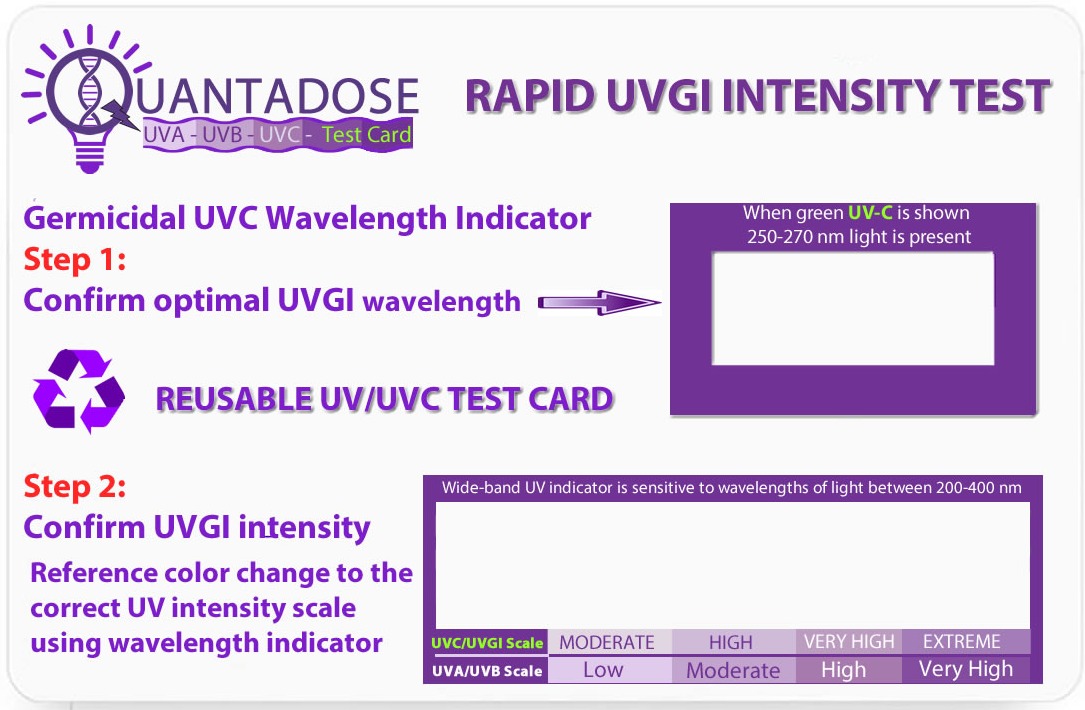
A professional-grade, reusable UVC test card. It's made of UV-resilient PVC for higher-power UVC devices and has higher contrast and batch numbers for quality control.
Source: www.quantadose.comWhat changed from the 1st Edition?
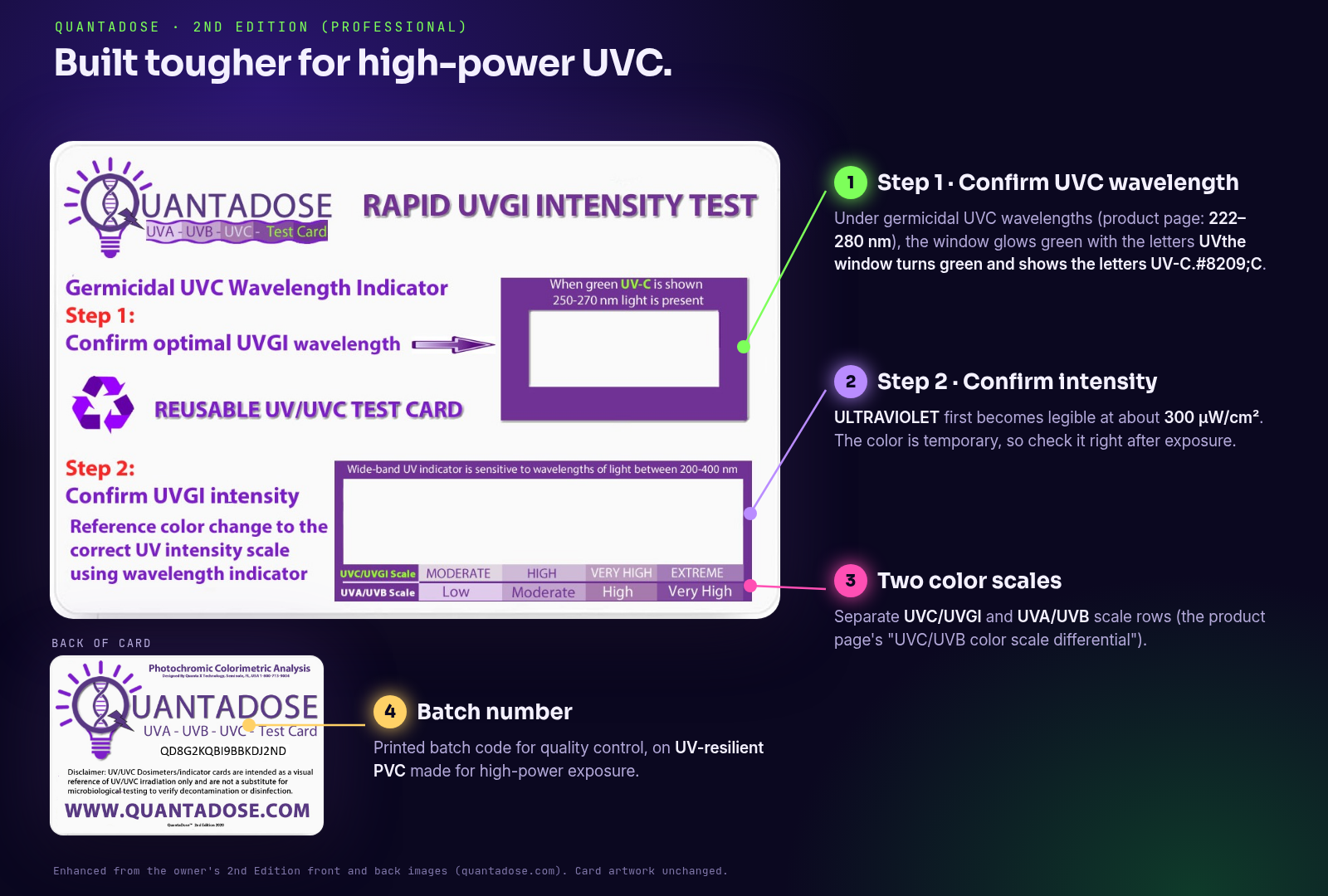
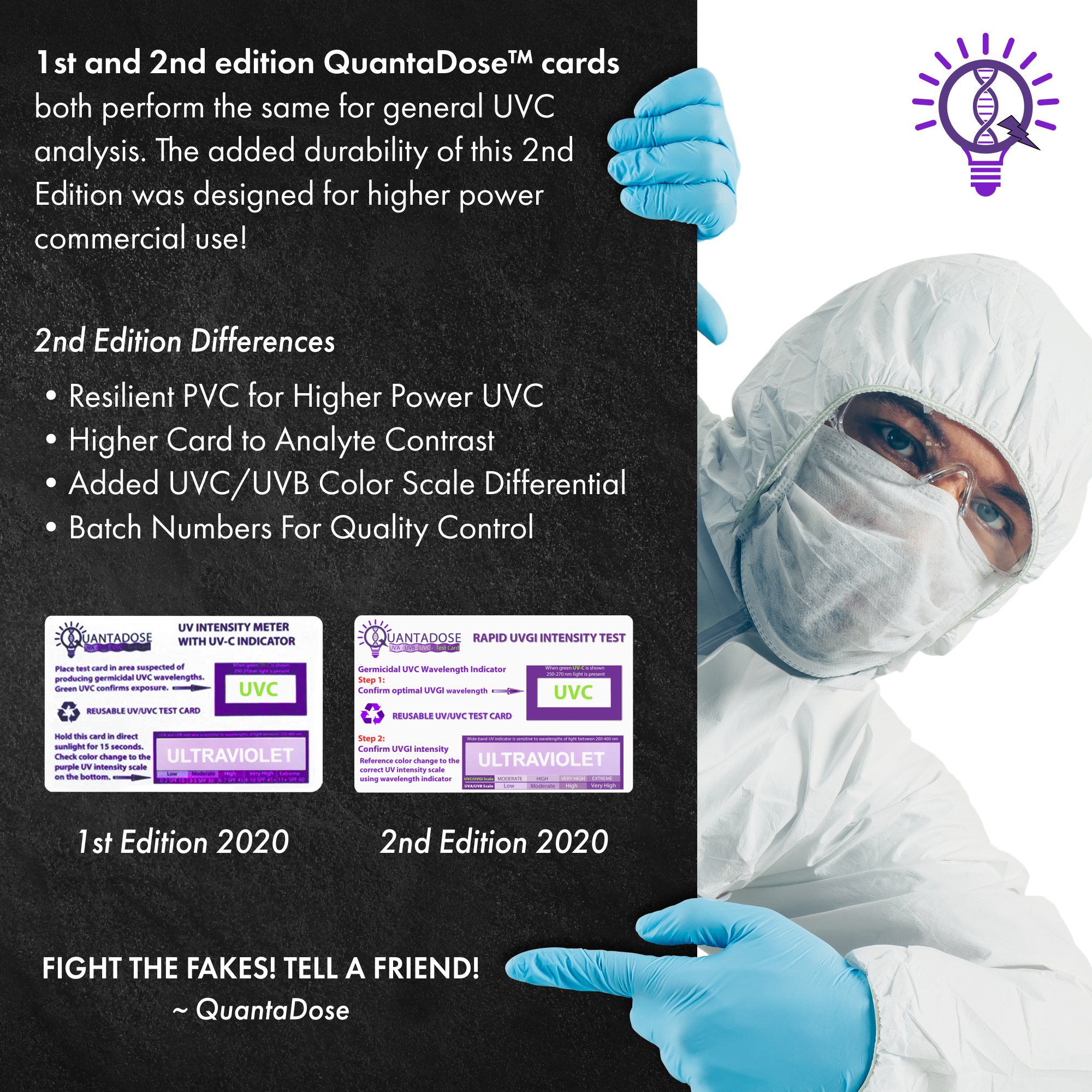
The product page lists four changes: resilient PVC for higher-power UVC, higher card-to-analyte contrast, an added UVC/UVB color scale differential, and batch numbers for quality control.
Source: www.quantadose.comDo the 1st and 2nd Edition perform differently?
For general UVC analysis they perform the same. The 2nd Edition's added durability is for higher-power commercial use.
Source: www.quantadose.comWhy is it called a 3-in-1 card?
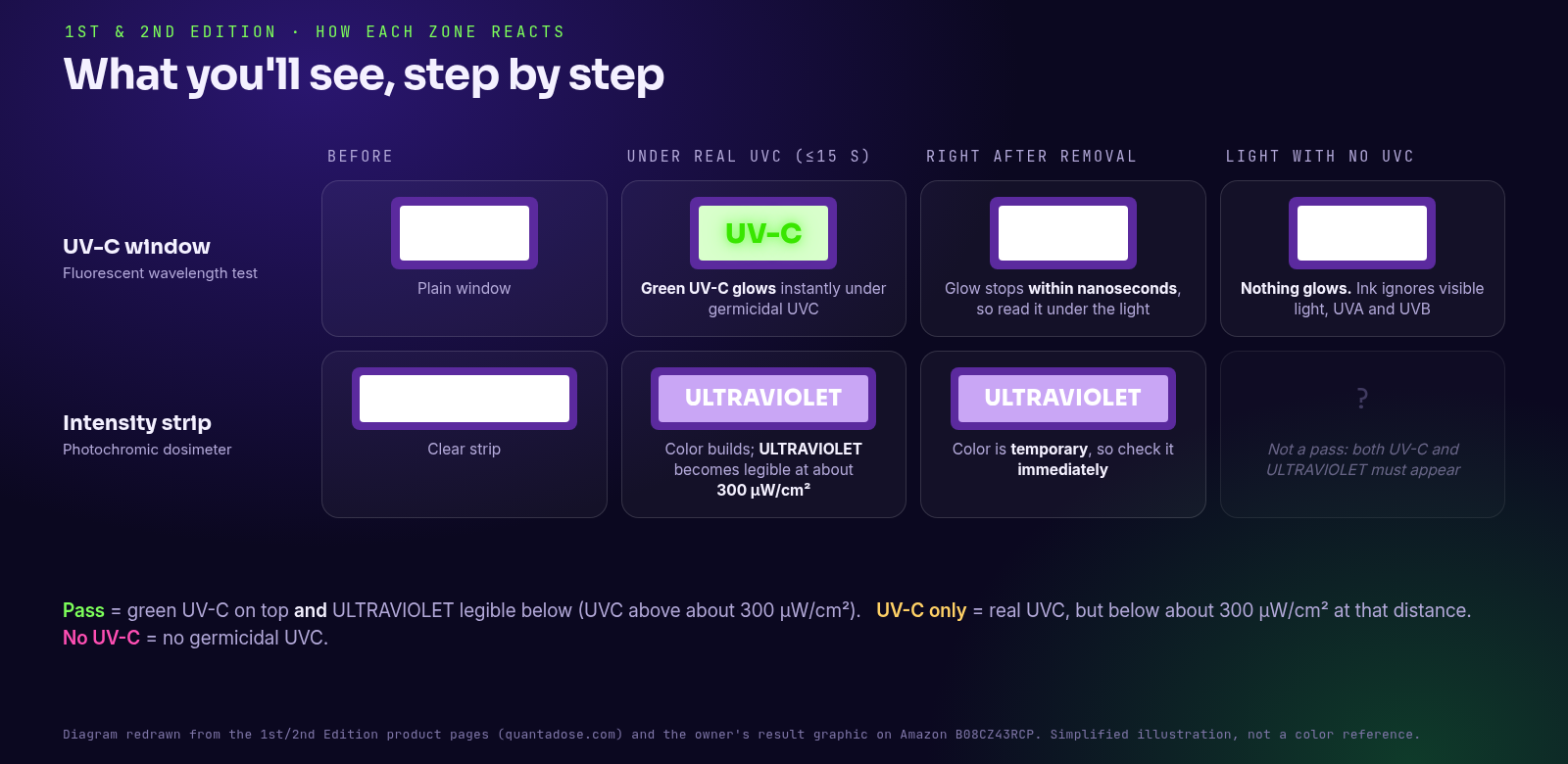
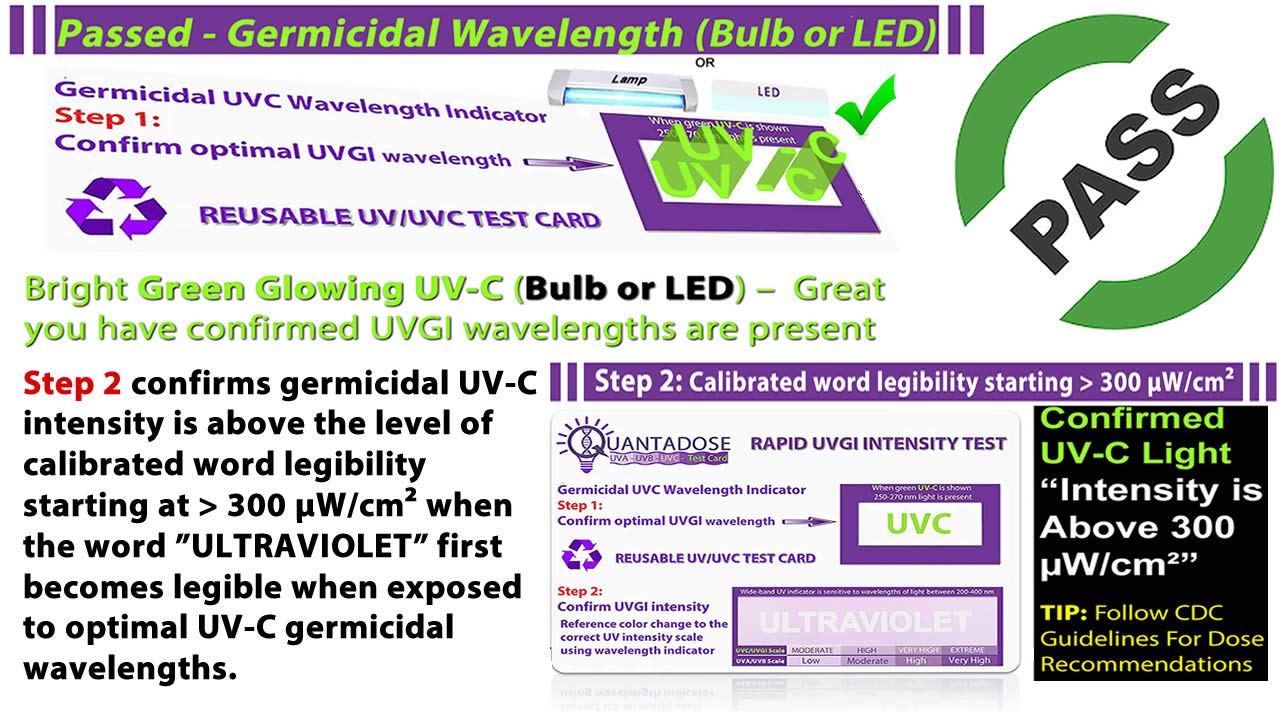
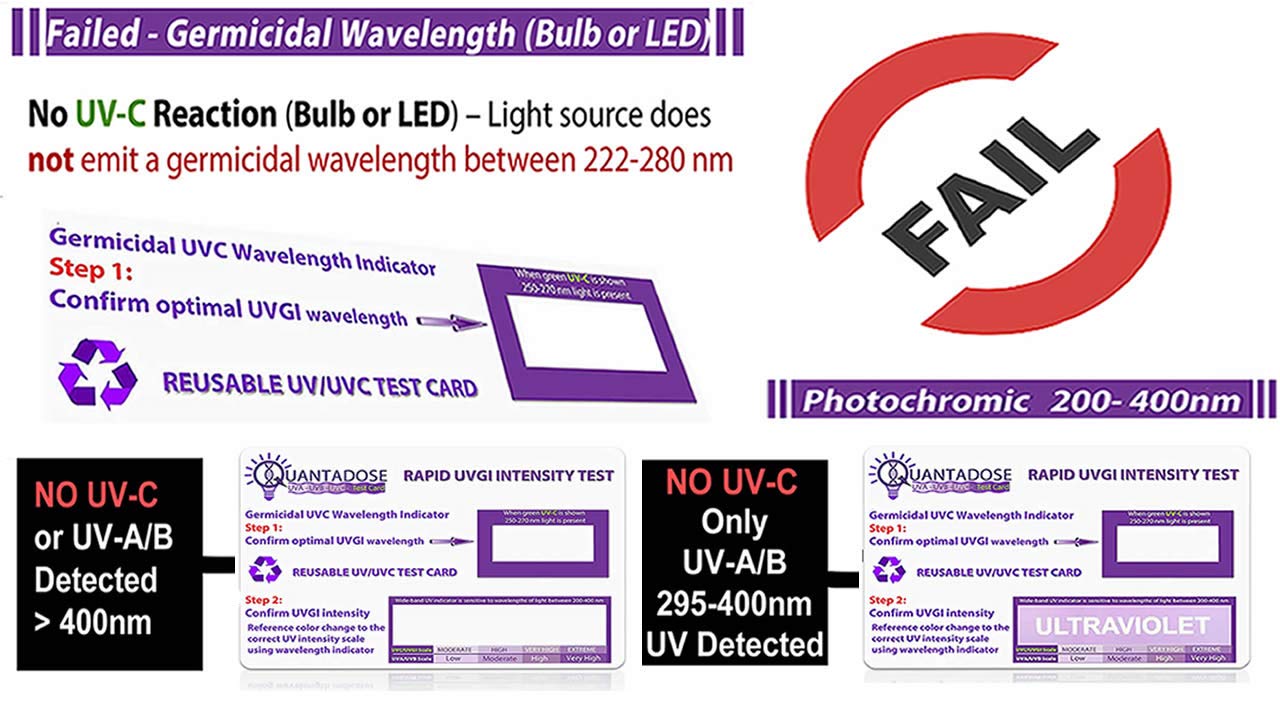
Because it runs three tests: a UVC wavelength test (the letters UV-C glow green), a wideband photochromic UV indicator that turns purple, and an intensity check where the word ULTRAVIOLET becomes readable once UVC intensity reaches about 300 µW/cm². The intensity check is calibrated under UVC. The purple strip darkens much more easily under UVA/UVB than under UVC, so for UVC rely on the green UV-C letters and the ULTRAVIOLET word.
How do I use it?
Step 1: hold the card under the light and watch the top window. Under germicidal UVC it turns green and shows UV-C. Step 2: check the bottom strip right away. The test is complete in 15 seconds, so then remove the card from the source. Safety: UV light can harm your eyes and skin, so wear proper safety equipment to protect them whenever you expose the card to the light. If the device you're testing, such as a UV sanitizer box, doesn't let you see the card while it's under the light, place your phone inside next to the card recording video, then watch the recording to see whether the green UV-C lit up. The fluorescent readout only shows while the card is in direct light.
Source: www.quantadose.comDo I need safety equipment?
Yes. Safety: UV light can harm your eyes and skin, so wear proper safety equipment to protect them whenever you expose the card to the light.
Source: QuantaDose (Quanta X Technology)
How do I test a UV sanitizer box I can't see into?
If the device you're testing, such as a UV sanitizer box, doesn't let you see the card while it's under the light, place your phone inside next to the card recording video, then watch the recording to see whether the green UV-C lit up. The fluorescent readout only shows while the card is in direct light.
Source: QuantaDose (Quanta X Technology)
Which wavelengths make UV-C glow?
What counts as a pass?
Both test areas have to respond: a glowing UV-C in the top test and the word ULTRAVIOLET in the lower test. Together they confirm UVC intensity is over 300 µW/cm².
Source: www.amazon.com (Amazon listing)What is WPV (Word Power Visibility)?
It's QuantaDose's name for its photochromic, calibrated word-legibility method. The word ULTRAVIOLET first becomes legible at 300 µW/cm² under optimal germicidal UVC wavelengths.
Source: www.quantadose.comWhat are the batch numbers for?
Why does the tougher PVC matter?
When should I read the intensity strip?
Immediately after exposure. The Step 2 photochromic color is temporary, and checking it right away gives the most accurate result.
Source: www.quantadose.comWhat are the two color scales on the strip?
The strip has a UVC/UVGI scale row and a UVA/UVB scale row. The product page calls this the added UVC/UVB color scale differential. The color change is a visual reference only.
Source: www.quantadose.comDoes it respond to Far-UV?
The product page says the analyte chemistry responds only to optimal germicidal wavelengths, and that germicidal wavelengths in Far-UV and UVC are shown by UV-C glowing green.
Source: www.quantadose.comCan it test a UV sanitizer box as well as a wand?
The wavelength test has to be watched while the card is under the light. One Amazon reviewer wrote: “...So, it may be suitable for checking a wand, but NOT a box such as the iHome sanitizer I wanted to check.” Tip: If the device you're testing, such as a UV sanitizer box, doesn't let you see the card while it's under the light, place your phone inside next to the card recording video, then watch the recording to see whether the green UV-C lit up. The fluorescent readout only shows while the card is in direct light.
Source: www.amazon.com (Amazon listing)Can it catch a UV disinfecting machine that doesn't work?
That's what it was built for. One Amazon reviewer wrote: “...Returned the bogus machine to Amazon. UV card saved my wallet a $100 and me from getting complacent in the safety department.”
Source: www.amazon.com (Amazon listing)How fast are the results?
The test takes 15 seconds. One Amazon reviewer wrote: “... Very quick response on spotting UVC. Takes a bit longer to tell you the intensity which is probably to be expected.”
Source: www.amazon.com (Amazon listing)Can I test sunglasses?
Detecting counterfeit UV-rated sunglasses is one of the off-label uses listed on the product page. One Amazon reviewer wrote: “Easy to use and really shows how cheap some sunglasses are.”
Source: www.amazon.com (Amazon listing)Can I check my windows?
Yes, as an off-label use. One Amazon reviewer wrote: “...I was able to verify that my windows are only letting through a very small amount of UV light, and that makes me feel much better.”
Source: www.amazon.com (Amazon listing)Can I use it for sunscreen decisions?
No. Per the required FDA notice, it should never be used to decide when to apply sunscreen. Consult your doctor.
Source: www.quantadose.comHow accurate is it?
The card is a visual check, and the color change is for visual reference only. One Amazon reviewer wrote: “Quality material. Great price. Pretty accurate when used correctly. The size of a credit card. Easy to Cary.”
Source: www.amazon.com (Amazon listing)Is there a support number on the card?
Is there a pack with both editions?
The product page offers a 2-card package with one 1st Edition and one 2nd Edition card, plus a filter kit. Check the site for current availability.
Source: www.quantadose.comWhere can I buy it, and what does it cost?
The product page lists quantadose.com, Amazon and Walmart Marketplace. Check each listing for the current price.
Source: www.quantadose.comWho do I contact with questions?
Do the cards expire? What is the shelf life?
We recommend replacing your card about once a year. That said, Quanta X Technology has tested properly sealed, unused cards over three years old and they still work like new. Store cards sealed, away from light and moisture.
Source: QuantaDose (Quanta X Technology)
Will sunlight wear out the card?
Yes. Sunlight and other UV slowly use up the card, so keep it out of the sun. Quanta X Technology says leaving a card in direct sunlight can burn it out in about an hour. Keep each test to about 15 seconds and store the card away from light and moisture between tests, for example in its black UV-resistant sleeve if it came with one, or anywhere dark and dry.
Source: www.amazon.com (Amazon listings, checked Nov 4, 2026)What do customers say? How are the reviews?
On Amazon, as checked November 4, 2026: the 1st Edition averages 4.5 out of 5 stars from 732 ratings, the 2nd Edition 4.5 stars from 561 ratings, and the 3rd Edition 6-in-1 4.4 stars from 307 ratings. Common themes are that it's easy and fast to use, and that it catches fake UVC sanitizers. One reviewer wrote, "I had 3 different UVC lights for sanitizing and only 1 is worth the money." People also use it to check sunglasses, car windows and reptile lamps. Some reviewers say sunlight or UVA/UVB readings can be hard to judge; the card is mainly designed for testing UV light sources.
Source: www.amazon.com (Amazon listings, checked Nov 4, 2026)Who makes QuantaDose? Tell me about the company.
QuantaDose is a brand of Quanta X Technology LLC, an American company in Seminole, Florida, founded in 2020 at the start of the pandemic. The team has engineering and biochemistry expertise, and its mission is to make tools that help fight pathogens. Besides the UVC test cards, Quanta X Technology does Far-UVC lighting design and manufacturing, with Far-UVC advisers to help people pick the right lighting. The company sells online.
Source: www.quantadose.comWhere can I buy QuantaDose cards?
You can order at quantadose.com or on Amazon. Quanta X Technology is the company that makes the cards, but orders aren't placed on a quantaxtechnology site. For questions, email info@quantadose.cards or call +1 (800) 713-9004.
Source: www.quantadose.comWhat are the indicators on the card made of?
The cards use special indicator inks, called analytes. There are fluorescent inks that glow green under UVC, or reddish-pink under UVA/UVB on the 6-in-1, and a photochromic ink that turns purple to show intensity. The 2nd Edition is printed on UV-resilient PVC made for high-power UVC. The exact ink formulas aren't published; for more detail I can forward you to a Quanta X Technology associate.
Source: www.quantadose.comHow does the glowing part of the card work?
In general science terms, a fluorescent material absorbs invisible UV light and gives it back right away as visible light, which is why you see a color glow. It only glows while the UV is hitting it and stops as soon as the light is removed. On QuantaDose cards, the ink in the UV-C letters is chosen to glow green under germicidal UVC, and on the 6-in-1, a longwave ink glows reddish-pink under UVA/UVB. That's why you read the green or pink while the card is still under the light.
Source: General science (not a product claim) ·
Card details: www.quantadose.comHow does the purple strip work?
In general science terms, a photochromic material changes color when UV light hits it, because the UV changes the shape of its molecules, and then it slowly fades back to clear once the UV is gone. Stronger UV changes more molecules, so the color is darker. On QuantaDose cards, the photochromic strip is clear before exposure and turns shades of purple after about 15 seconds under UV, giving a rough intensity reading. Read it right after you take the card out of the light, before it fades. It darkens more easily under UVA/UVB than UVC.
Source: General science (not a product claim) ·
Card details: www.quantadose.com