6-in-1 · Amazon 4.4★ avg · 307 ratings

3rd Edition 6-in-1

Six tests on one card. Green for UVC, red-pink for UVA/UVB, purple for intensity, a center circle that confirms >300 µW at 254 nm, and a Far-UVC beam detector on the back.

Questions about QuantaDose? Call(727) 888-5656and talk with our AI assistant any time.

Three colors: reddish-pink = UVA/UVB wavelength, green = UVC wavelength (both from the same test area), and purple = intensity, shown separately by the photochromic strip.

Read it under the light. The green (UVC) and reddish-pink (UVA/UVB) colors are fluorescent wavelength indicators. They glow only while the card is in direct light of that wavelength, and fade as soon as you take it out. The purple intensity strip is separate: it is photochromic and darkens after exposure.
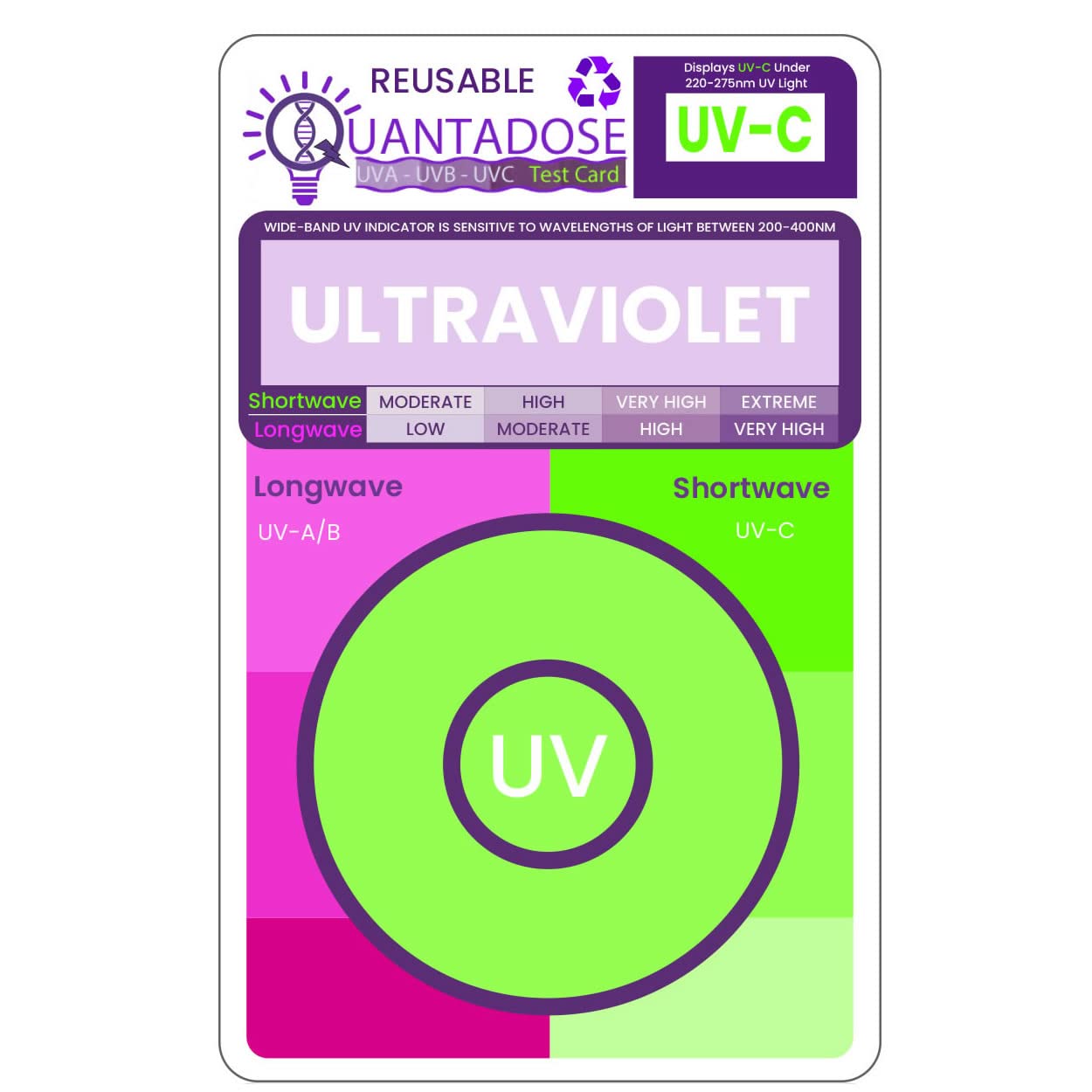
QuantaDose 3rd Edition 6-in-1 Multi-Wavelength Test Card (Amazon listing image)
Original · QuantaDose 3rd Edition 6-in-1 Multi-Wavelength Test Card (Amazon listing image)
6tests, both sides
≤15 smax exposure
>300 µWcenter-circle check at 254 nm
>500tests with 15 s exposures
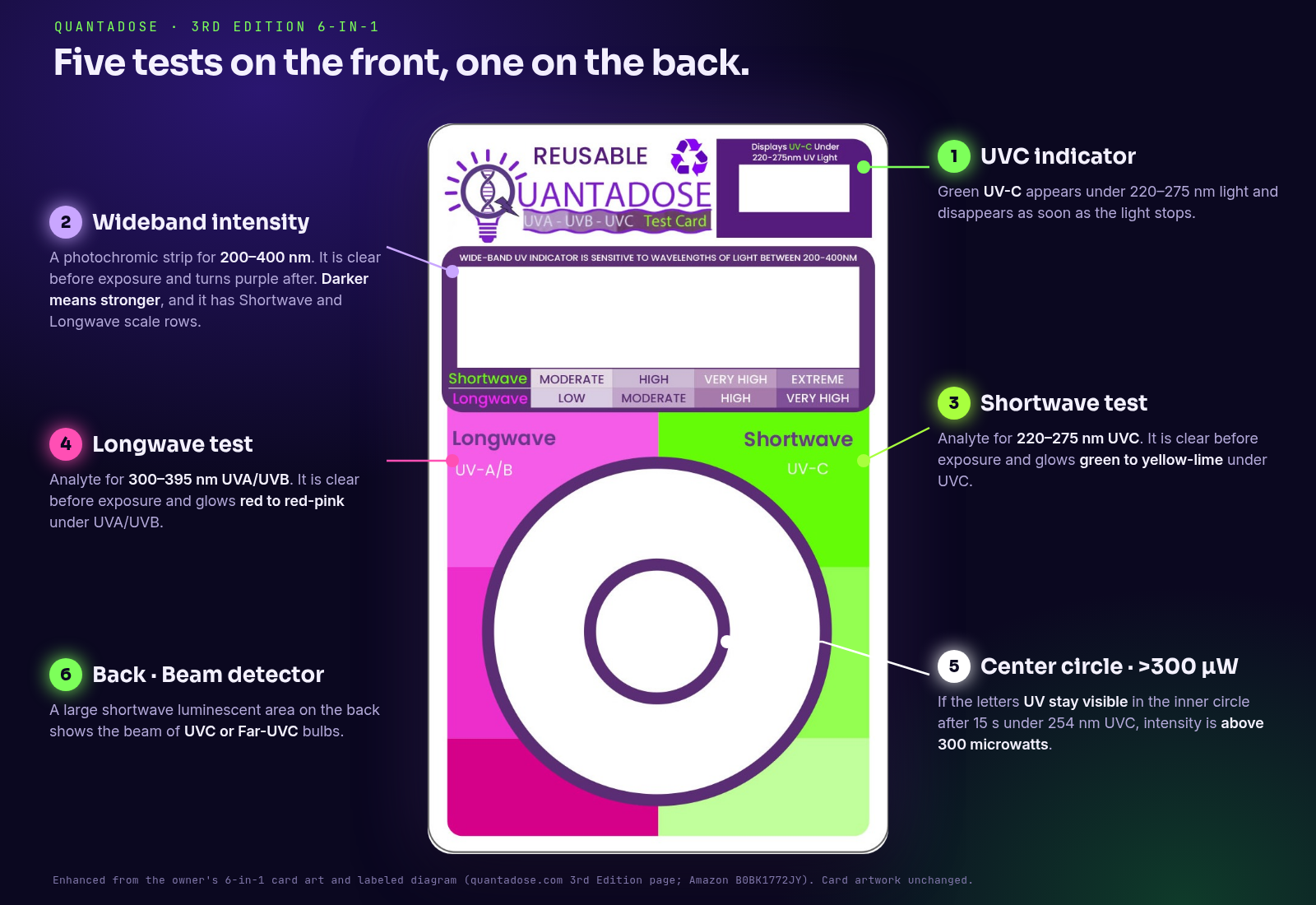
Anatomy · front

Five tests on the front.

6-in-1 front, cleaned crop with six numbered callouts from the product page and Amazon listing.
● Improved · 6-in-1 front, cleaned crop with six numbered callouts from the product page and Amazon listing.
Anatomy · back

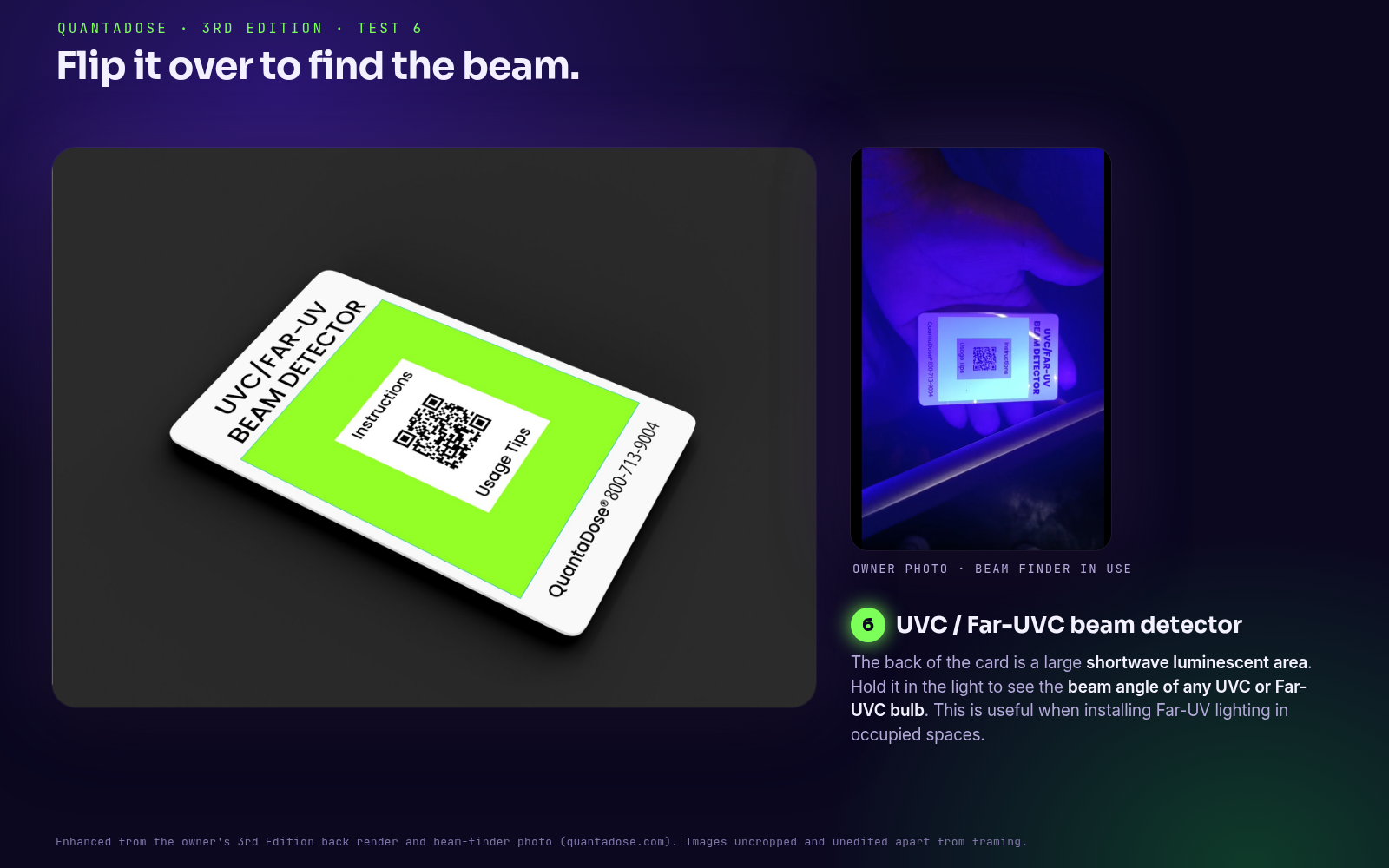
Test six: find the beam.

6-in-1 back render and owner beam-finder photo, framed with callout.
● Improved · 6-in-1 back render and owner beam-finder photo, framed with callout.
How each zone reacts

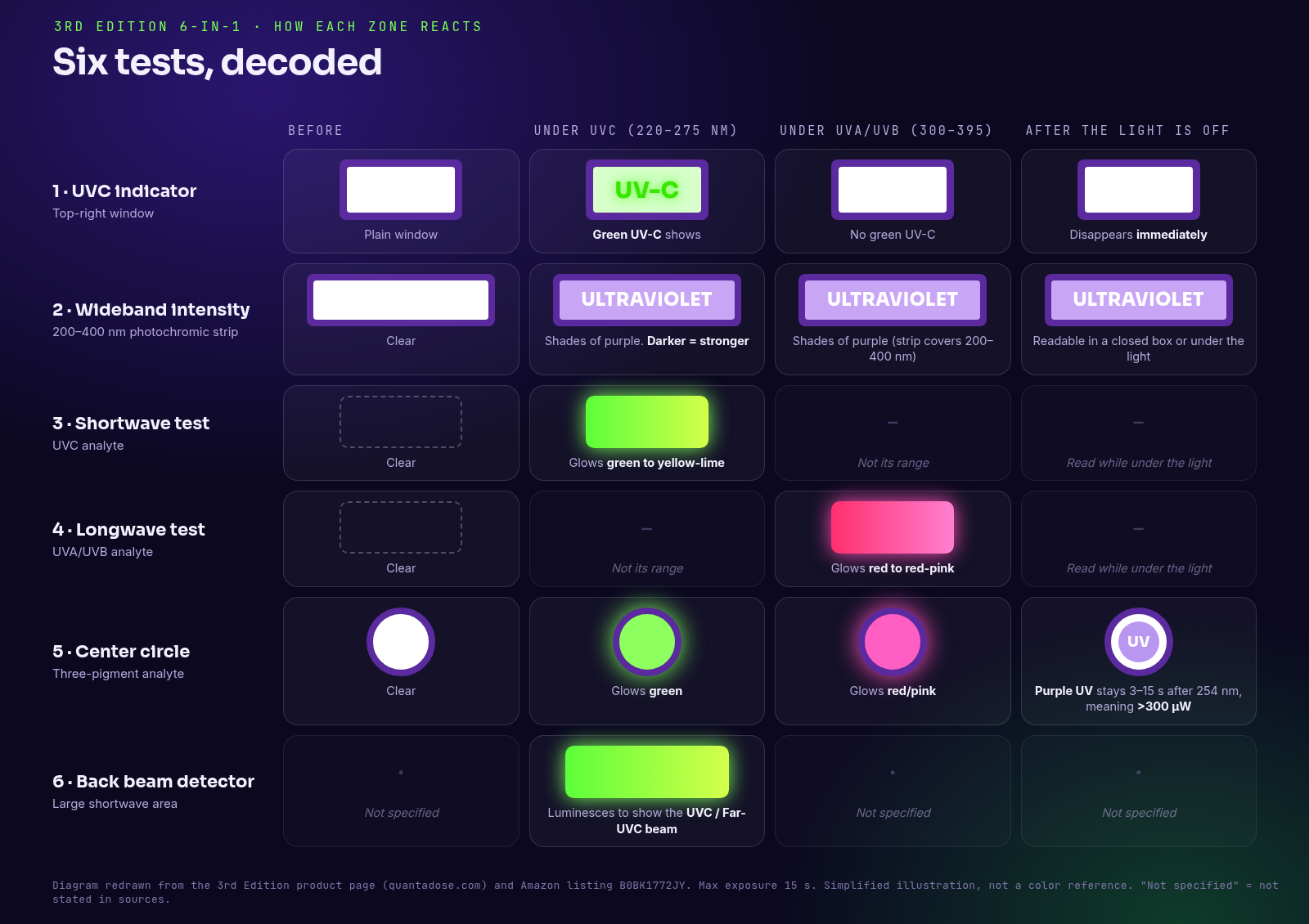
Six tests, decoded.

Zone-by-zone reaction matrix, redrawn from the product page and Amazon listing.
● Improved · Zone-by-zone reaction matrix, redrawn from the product page and Amazon listing.
Reading results

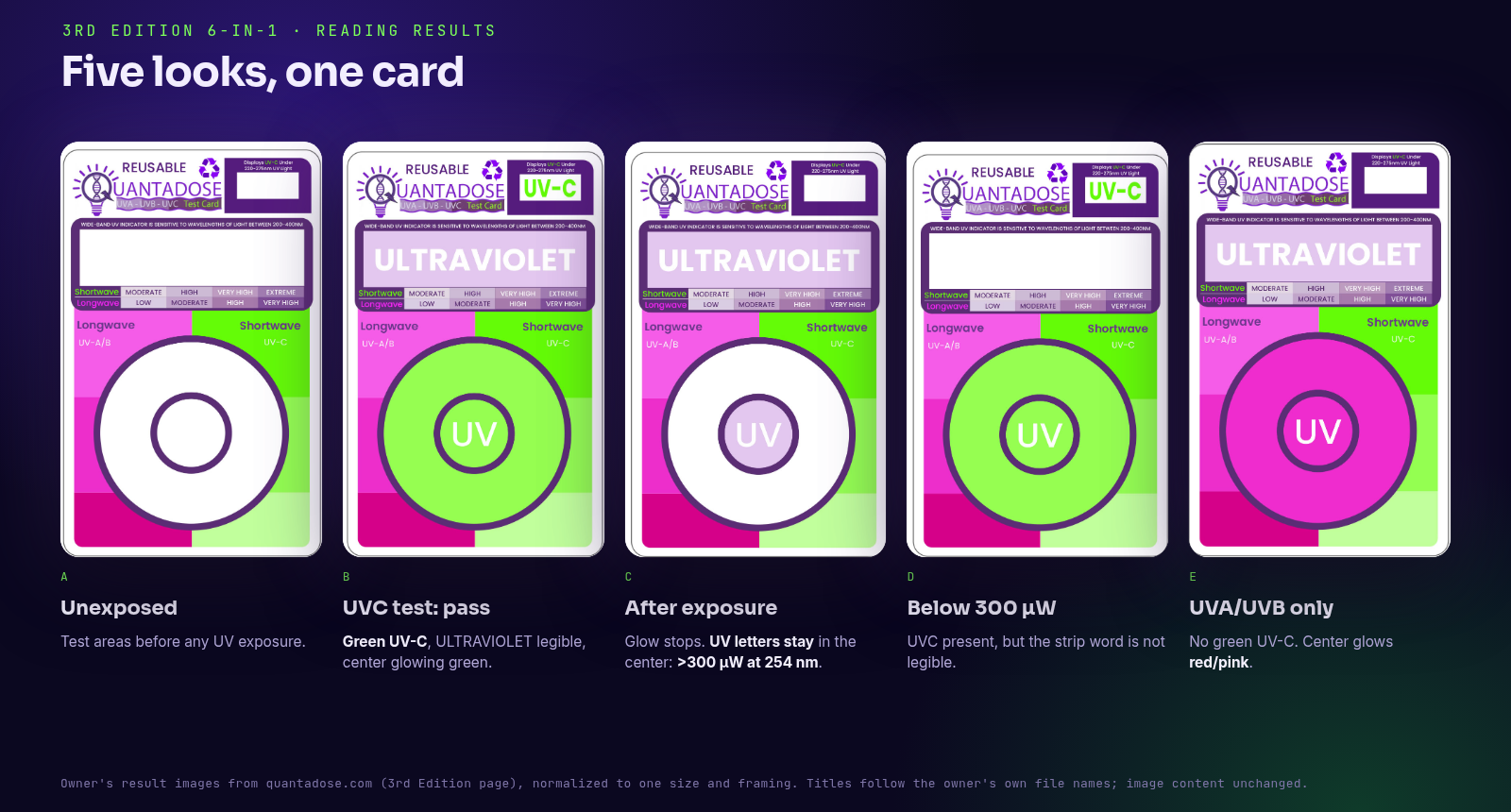
What each result looks like.

Owner result images normalized into one comparison strip.
● Improved · Owner result images normalized into one comparison strip.
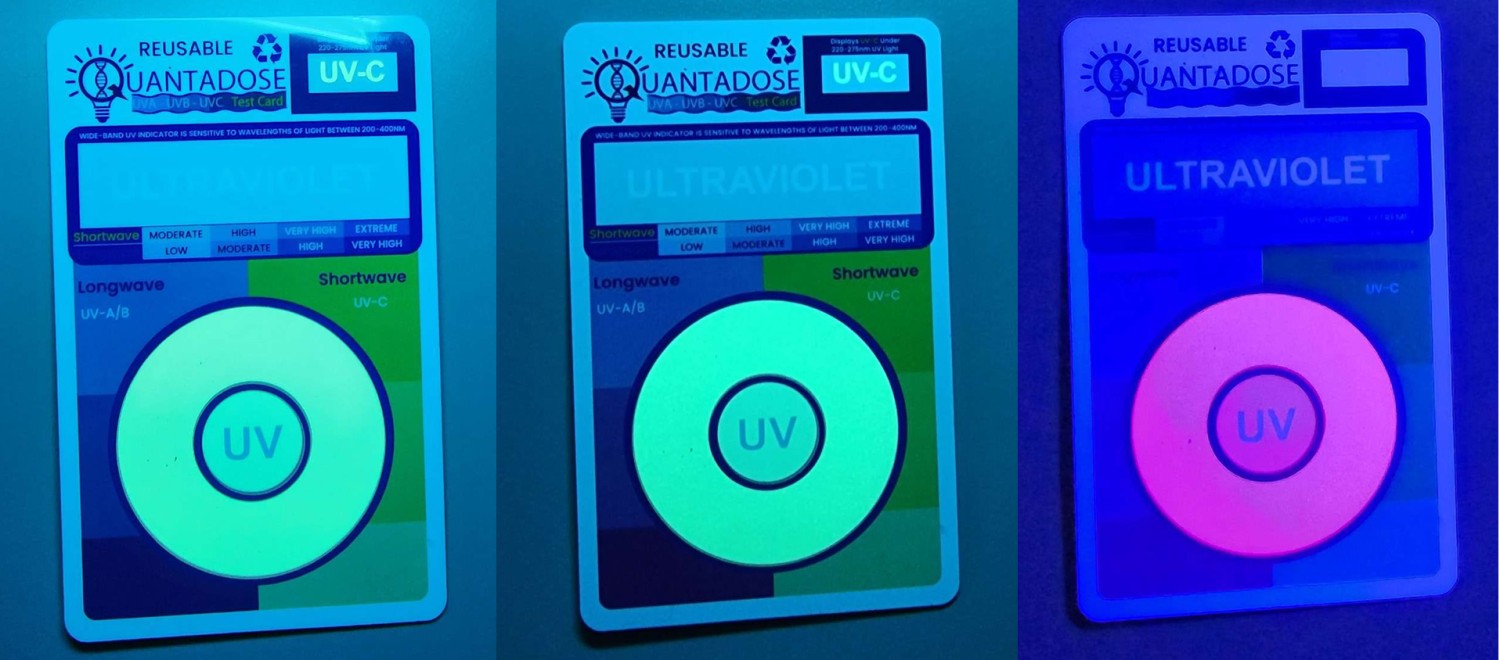
Owner photo: real cards under UV (quantadose.com).
Original · Owner photo: real cards under UV (quantadose.com).

Under UVC the center glows green. Under UVA/UVB it glows red-pink. Right after the light goes off, a purple shade shows intensity, and the UV letters stay for a few seconds if 254 nm UVC was above 300 µW.

Full usage instructions: quantadose.com/v3/ (also on the QR code on the back of the card).

From Amazon reviews

What 3rd Edition 6-in-1 owners say.

This UV test card differentiated true and fake UVC disinfection devices instantly by checking the presence of shortwave UVC or deep UV....
Amazon reviewer·3rd Edition 6-in-1·★ 4.4listing avg (307 ratings)·source
I was looking for an inexpensive way to compare the effectiveness of low cost UVC sterilization products and this is it!...
Amazon reviewer·3rd Edition 6-in-1·★ 4.4listing avg (307 ratings)·source
This is super easy to use to confirm the existence of UVA/UVB and/or UVC. Super easy to use, reusable and very compact....
Amazon reviewer·3rd Edition 6-in-1·★ 4.4listing avg (307 ratings)·source
...A great alternative to very expensive digital UV light meters.
Amazon reviewer·3rd Edition 6-in-1·★ 4.4listing avg (307 ratings)·source
This is a great product for anyone wanting to make sure their UV-C actually works....
Amazon reviewer·3rd Edition 6-in-1·★ 4.4listing avg (307 ratings)·source
...With my original light on the color changes in the card is instantaneous! So I know that this card works as promised and it does so quickly....
Amazon reviewer·3rd Edition 6-in-1·★ 4.4listing avg (307 ratings)·source

Verbatim excerpts from the Amazon listing's "Customers say" section. Ellipses are Amazon's. The stars show the listing's average (4.4★, 307 ratings, checked Nov 4, 2026); individual ratings are only shown to signed-in shoppers.

FAQ · 34 questions

Questions people actually ask

Answers come from the QuantaDose product page, the Amazon listing, and common questions in Amazon reviews.

What is the 3rd Edition 6-in-1 card?
A reusable multi-wavelength test card with tests on both sides. The front has five tests: a UVC indicator, a wideband UV intensity strip, a shortwave test, a longwave UVA/UVB test, and a center circle that confirms more than 300 µW at 254 nm. The back is a UVC/Far-UVC beam detector.
Source: www.quantadose.com
How do I use it?
Expose the card to the light for no more than 15 seconds. Watch the UVC test while the card is under the light, because the letters disappear as soon as it's removed. The intensity test can be read in a closed box or directly under the light. Safety: UV light can harm your eyes and skin, so wear proper safety equipment to protect them whenever you expose the card to the light. If the device you're testing, such as a UV sanitizer box, doesn't let you see the card while it's under the light, place your phone inside next to the card recording video, then watch the recording to see whether the green UV-C lit up. The fluorescent readout only shows while the card is in direct light.
Source: www.quantadose.com
Do I need safety equipment?
Yes. Safety: UV light can harm your eyes and skin, so wear proper safety equipment to protect them whenever you expose the card to the light.
Source: QuantaDose (Quanta X Technology)
How do I test a UV sanitizer box I can't see into?
If the device you're testing, such as a UV sanitizer box, doesn't let you see the card while it's under the light, place your phone inside next to the card recording video, then watch the recording to see whether the green UV-C lit up. The fluorescent readout only shows while the card is in direct light.
Source: QuantaDose (Quanta X Technology)
What does green mean, and what does pink mean?
The center test glows green under 220–275 nm UVC and red/pink under 300–395 nm UVA/UVB. After exposure ends it shows a purple color.
Source: www.quantadose.com
What does it mean if the letters UV stay in the center circle?
If the letters UV remain visible in the inner circle after the card is removed from 254 nm UVC, intensity is greater than 300 microwatts. The Amazon listing says the letters show for a brief time (3–15 seconds).
Source: www.amazon.com (Amazon listing)
What does “bi-luminescent” mean?
The card glows in two colors to tell longwave UVA apart from shortwave UVC. A third color, a residual shade of purple, indicates UV intensity in 15 seconds.
Source: www.amazon.com (Amazon listing)
What does the shortwave test do?
The shortwave analyte responds to 220–275 nm UVC. It's clear before exposure and glows green to yellow-lime under a shortwave UVC source.
Source: www.amazon.com (Amazon listing)
What does the longwave test do?
The longwave analyte responds to 300–395 nm UVA/UVB. It's clear before exposure and glows red to red-pink under a longwave UV source.
Source: www.amazon.com (Amazon listing)
How do I read the wideband intensity strip?
The photochromic strip responds to 200–400 nm UVA/UVB/UVC. It's clear before exposure and shows shades of purple after. Higher intensity makes a darker color, and at max value shorter wavelengths give a lighter color.
Source: www.quantadose.com
Can I estimate UV dose?
The product page gives the formula: UV dose = UV intensity × exposure time in seconds. Use >300 µW/cm² when the letters UV remain visible after 15 seconds.
Source: www.quantadose.com
What is the beam detector on the back for?
It shows the beam angle of any UVC or Far-UVC bulb across a large luminescent area. That's useful for professional UVGI installers, including when installing Far-UV lighting in occupied spaces.
Source: www.amazon.com (Amazon listing)
Does it work with Far-UVC lamps?
The back beam detector is designed for UVC and Far-UVC bulbs, and the shortwave analyte is listed as sensitive to 220–275 nm.
Source: www.amazon.com (Amazon listing)
Can I test UV flashlights or nail gel lamps?
Yes. The Amazon listing calls it perfect for testing 365 nm/395 nm UV flashlights and professional nail gel UV lights. The product page also suggests checking whether an aging nail-curing lamp is still strong enough.
Source: www.amazon.com (Amazon listing)
Can I test a reptile UVB lamp?
Yes. The product page suggests testing the intensity left in your reptile lamp, and the Amazon listing says the strip is perfect for testing UVB reptile lights.
Source: www.quantadose.com
Can I test sunglasses or car window film?
Yes. The product page suggests checking whether UV-blocking glasses and car window film block UV as claimed. One Amazon reviewer wrote: “...this card showed my glasses work because it prevented the uv ray from showing anything on the card. I'll buy it again and highly recommend it.”
Source: www.quantadose.com
Is it good for the classroom?
The product page says experiments on ultraviolet light and fluorescence are easy to do in the classroom to explore different wavelengths of the UV spectrum.
Source: www.quantadose.com
How should I store it, and how many tests does it last?
Reusable for up to about 300 fifteen-second tests under UVC when stored properly, away from light and moisture.
Source: www.amazon.com (Amazon listing)
The reading fades before I can look at it. What should I do?
Read it right away. The UVC letters disappear immediately when the light is off, and the center UV letters show for only about 3–15 seconds. Watch the UVC test under the light, and read the center circle as soon as you remove the card.
Source: www.amazon.com (Amazon listing)
Where are the full instructions?
The product page links to usage instructions at quantadose.com/v3/. The back of the card also has a QR code labeled Instructions and Usage Tips.
Source: www.quantadose.com
Can it tell a real UVC disinfection device from a fake one?
Yes, that's the main use. One Amazon reviewer wrote: “This UV test card differentiated true and fake UVC disinfection devices instantly by checking the presence of shortwave UVC or deep UV....”
Source: www.amazon.com (Amazon listing)
Is it a replacement for a UV meter?
It's a quick visual check rather than a digital meter. One Amazon reviewer wrote: “...A great alternative to very expensive digital UV light meters.”
Source: www.amazon.com (Amazon listing)
Does it work in sunlight?
The Amazon listing says the wideband strip responds to artificial or natural light between 200–400 nm. The shortwave and longwave analytes are described for artificial sources. Don't use the card for sunscreen decisions (see the FDA notice).
Source: www.amazon.com (Amazon listing)
How is it different from the 1st and 2nd Edition?
It adds dedicated longwave UVA/UVB and shortwave tests, a center circle that confirms >300 µW at 254 nm, and a Far-UVC beam detector on the back, for six tests in total.
Source: www.quantadose.com
Where can I buy it, and what does it cost?
The 6-in-1 is available on Amazon and Walmart. Check each listing for the current price.
Source: www.quantadose.com
Who do I contact with questions?
Email Quanta X Technology support at info@quantadose.cards.
Source: www.quantadose.com
Do the cards expire? What is the shelf life?
We recommend replacing your card about once a year. That said, Quanta X Technology has tested properly sealed, unused cards over three years old and they still work like new. Store cards sealed, away from light and moisture.
Source: QuantaDose (Quanta X Technology)
Will sunlight wear out the card?
Yes. Sunlight and other UV slowly use up the card, so keep it out of the sun. Quanta X Technology says leaving a card in direct sunlight can burn it out in about an hour. Keep each test to about 15 seconds and store the card away from light and moisture between tests, for example in its black UV-resistant sleeve if it came with one, or anywhere dark and dry.
Source: www.amazon.com (Amazon listings, checked Nov 4, 2026)
What do customers say? How are the reviews?
On Amazon, as checked November 4, 2026: the 1st Edition averages 4.5 out of 5 stars from 732 ratings, the 2nd Edition 4.5 stars from 561 ratings, and the 3rd Edition 6-in-1 4.4 stars from 307 ratings. Common themes are that it's easy and fast to use, and that it catches fake UVC sanitizers. One reviewer wrote, "I had 3 different UVC lights for sanitizing and only 1 is worth the money." People also use it to check sunglasses, car windows and reptile lamps. Some reviewers say sunlight or UVA/UVB readings can be hard to judge; the card is mainly designed for testing UV light sources.
Source: www.amazon.com (Amazon listings, checked Nov 4, 2026)
Who makes QuantaDose? Tell me about the company.
QuantaDose is a brand of Quanta X Technology LLC, an American company in Seminole, Florida, founded in 2020 at the start of the pandemic. The team has engineering and biochemistry expertise, and its mission is to make tools that help fight pathogens. Besides the UVC test cards, Quanta X Technology does Far-UVC lighting design and manufacturing, with Far-UVC advisers to help people pick the right lighting. The company sells online.
Source: www.quantadose.com
Where can I buy QuantaDose cards?
You can order at quantadose.com or on Amazon. Quanta X Technology is the company that makes the cards, but orders aren't placed on a quantaxtechnology site. For questions, email info@quantadose.cards or call +1 (800) 713-9004.
Source: www.quantadose.com
What are the indicators on the card made of?
The cards use special indicator inks, called analytes. There are fluorescent inks that glow green under UVC, or reddish-pink under UVA/UVB on the 6-in-1, and a photochromic ink that turns purple to show intensity. The 2nd Edition is printed on UV-resilient PVC made for high-power UVC. The exact ink formulas aren't published; for more detail I can forward you to a Quanta X Technology associate.
Source: www.quantadose.com
How does the glowing part of the card work?
In general science terms, a fluorescent material absorbs invisible UV light and gives it back right away as visible light, which is why you see a color glow. It only glows while the UV is hitting it and stops as soon as the light is removed. On QuantaDose cards, the ink in the UV-C letters is chosen to glow green under germicidal UVC, and on the 6-in-1, a longwave ink glows reddish-pink under UVA/UVB. That's why you read the green or pink while the card is still under the light.
Source: General science (not a product claim) · Card details: www.quantadose.com
How does the purple strip work?
In general science terms, a photochromic material changes color when UV light hits it, because the UV changes the shape of its molecules, and then it slowly fades back to clear once the UV is gone. Stronger UV changes more molecules, so the color is darker. On QuantaDose cards, the photochromic strip is clear before exposure and turns shades of purple after about 15 seconds under UV, giving a rough intensity reading. Read it right after you take the card out of the light, before it fades. It darkens more easily under UVA/UVB than UVC.
Source: General science (not a product claim) · Card details: www.quantadose.com

Still have a question?

Email Quanta X Technology support: info@quantadose.cards